A lot of doctors spend more time picking a car than picking their disability insurance.
I get it. The policies are long. The words are strange. And you’re busy taking care of patients.
But this one matters. For most doctors, the ability to earn is the most valuable thing they own. Disability insurance is how you protect it.
I’ve spent my career working around physicians, and my team at Pattern has helped more than 50,000 doctors understand their disability and life insurance options. This guide is what I’d tell a friend in residency over coffee. No jargon. Just what matters.
I first wrote this in 2024. This version has 2026 numbers, a few new sections, and a lot fewer words.
What’s inside
- What disability insurance is, and why doctors need it more
- Short-term vs. long-term coverage
- The definition of disability (the part that matters most)
- The features worth paying for
- Who sells true own-occupation coverage
- What it costs and how to pay less
- Your employer’s plan vs. your own policy
- “Won’t Social Security cover me?”
- How to buy it
- FAQ and a checklist
1. What disability insurance is
Disability insurance pays you a monthly check if an illness or injury keeps you from working.
That’s it. It’s insurance on your paycheck.
And for doctors, that paycheck is huge. The average physician earned $386,000 in 2025. Over a 30-year career, that’s more than $11 million, before a single raise.
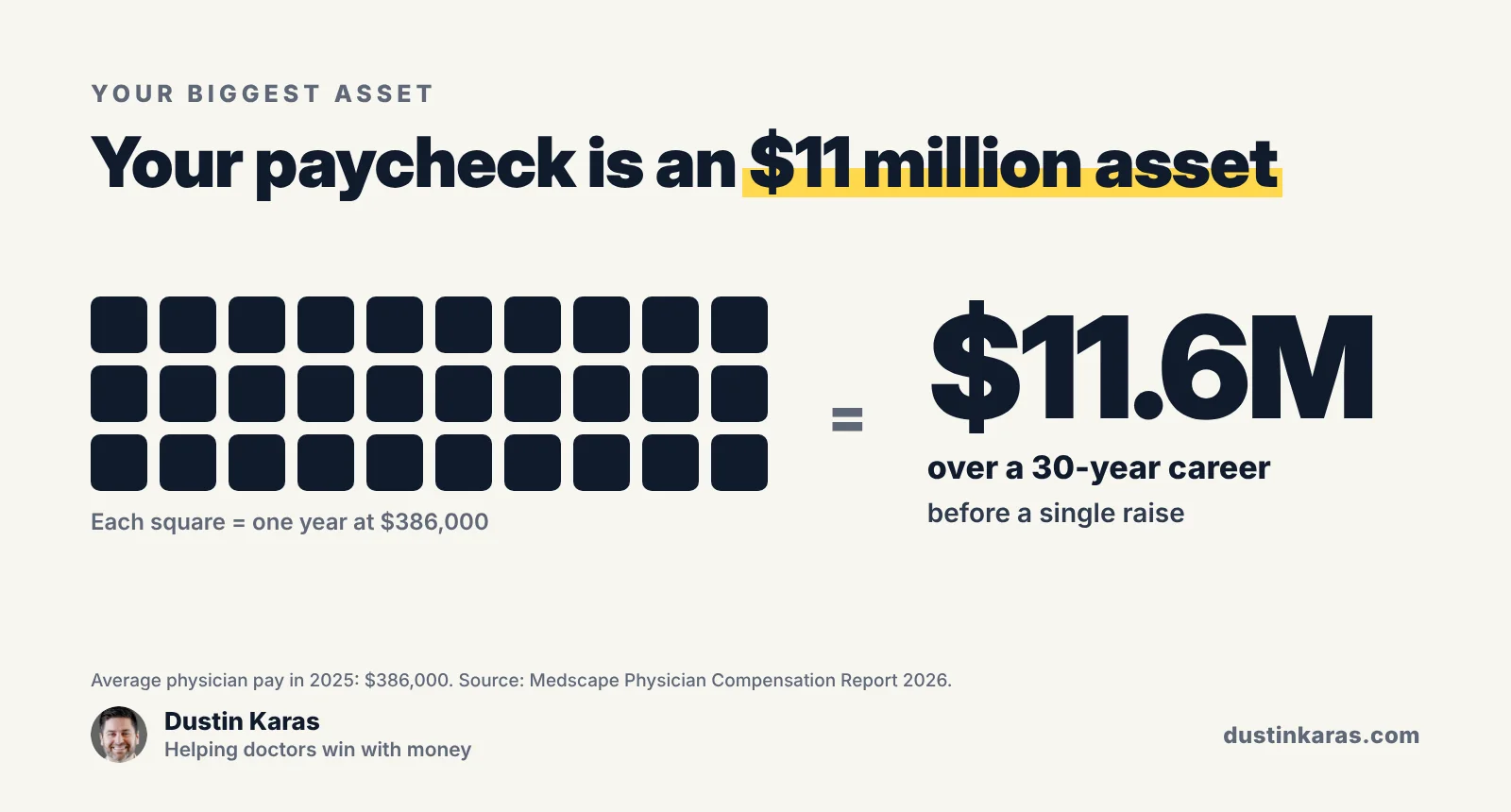
You insure your house and your car without thinking twice. The paycheck that pays for both is worth far more than either.
It happens more than you’d think
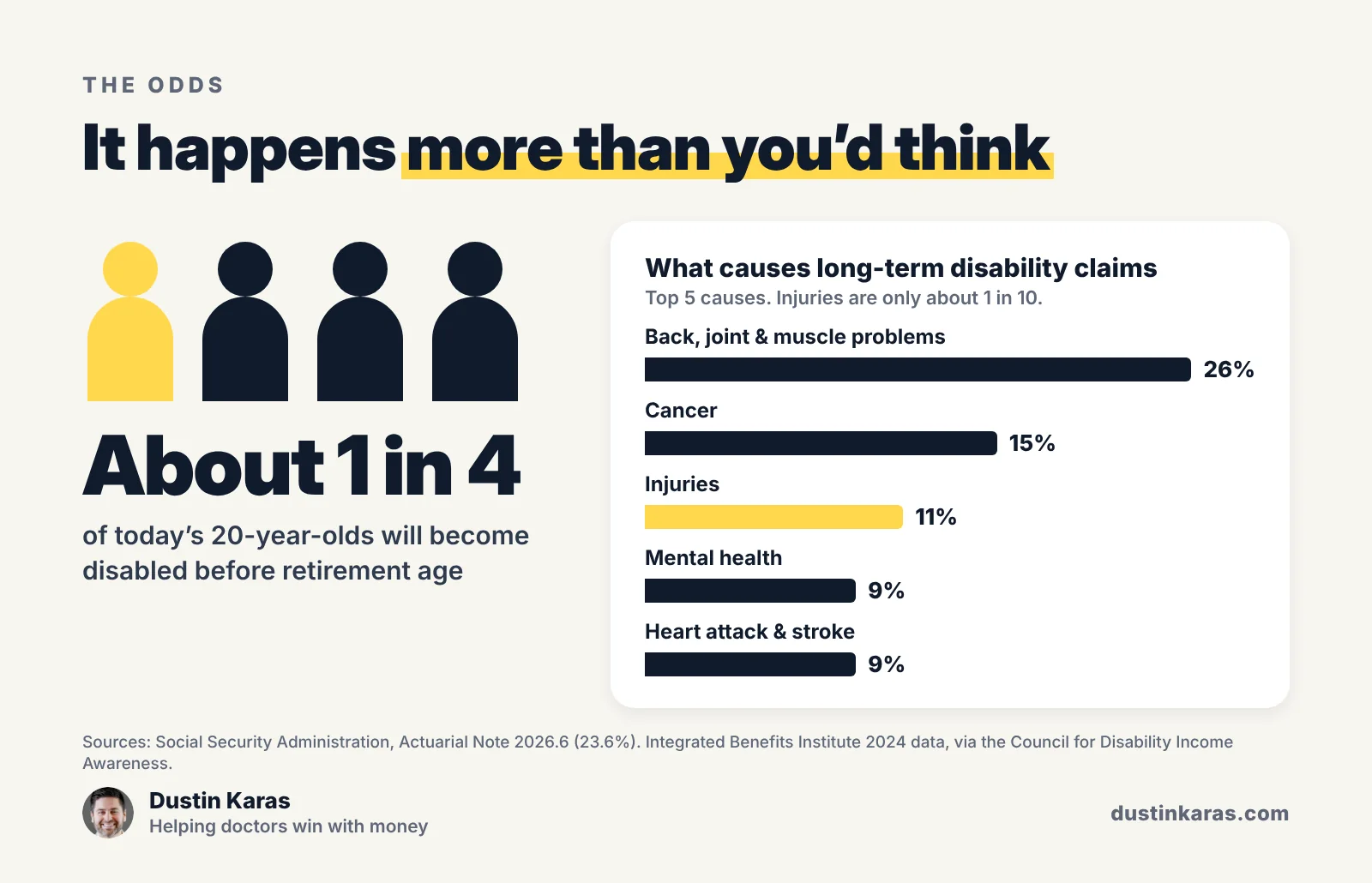
About 1 in 4 of today’s 20-year-olds will become disabled before they reach retirement age. That’s from Social Security’s own actuaries.
And it’s usually not a dramatic accident. Injuries cause only about 11% of long-term disability claims. The big causes are back and joint problems, cancer, mental health conditions, and heart attacks or strokes.
For a doctor, a small problem can become a career problem. A tremor. A bad shoulder. Numbness in your hands. Plenty of people could keep working through those. A surgeon might not.
Your loans don’t go away
Federal student loans can be wiped out if you become totally and permanently disabled. But the bar is high. You basically have to be unable to do any real work for at least five years. A surgeon who can’t operate but can still teach won’t qualify. Private loans have their own rules.
Your mortgage, your car payment, and your kids’ needs keep coming too. Disability insurance is what keeps the lights on.
2. Short-term vs. long-term disability insurance
Both pay part of your income when you can’t work. The difference is when they start and how long they last.
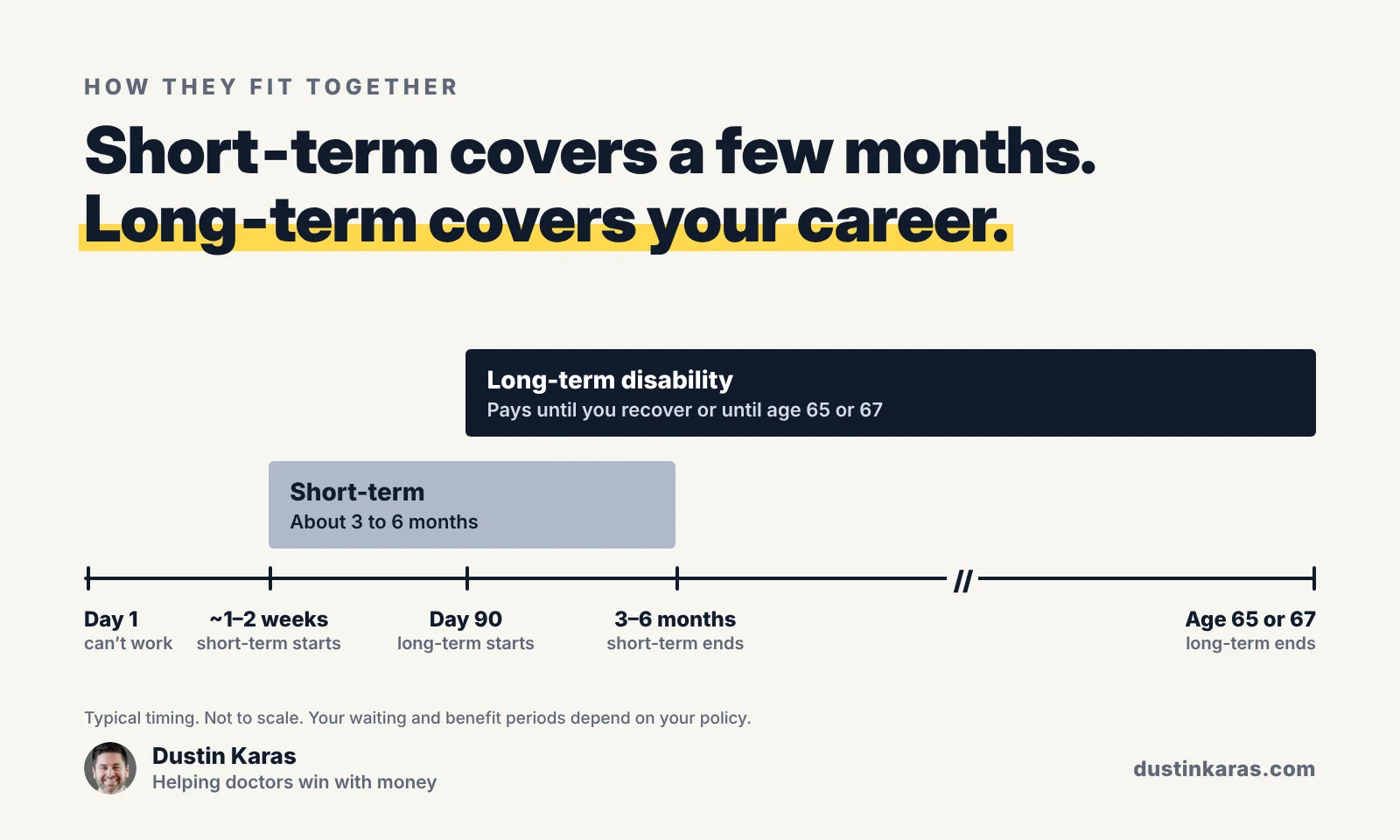
Short-term disability usually starts within a week or two and lasts about 3 to 6 months. It often replaces 50% to 80% of your pay. Common claims: recovery after childbirth, surgery, back injuries, and car accidents.
Many employers include it in your benefits. If yours doesn’t, I usually tell doctors to skip buying their own. An emergency fund that covers a few months of expenses does the same job without the premiums.
One thing to plan for: if you’re counting on short-term disability for maternity leave, the coverage needs to be in place before you’re pregnant.
Long-term disability is the one that protects your career. It usually starts after a 90-day waiting period and can pay until you recover or until the benefit period ends, often at age 65 or 67.
Short-term covers a rough few months. Long-term covers the scenario where you can’t go back. That’s the policy the rest of this guide is about.
3. The definition of disability (the part that matters most)
If you remember one thing from this guide, make it this.
To get paid, you have to meet your policy’s definition of disability. Two policies can look almost the same and pay very differently because of a few words.
There are four main definitions:
- True own-occupation (specialty-specific). If you can’t do the main duties of your specialty, you’re disabled. Even if you go work somewhere else and earn money. You get your full benefit.
- Transitional own-occupation. Same idea, with a catch. If you work in another job, your benefit plus your new income can’t add up to more than you used to earn. The policy pays the gap.
- Modified own-occupation. You’re paid only if you can’t do your specialty and you’re not working. Take another job and your benefit stops.
- Any occupation. You’re paid only if you can’t do any job you’re reasonably suited for by education, training, or experience. This is the weakest definition, and it’s the most common one in employer plans.
It’s easier to see with an example.
Dr. Sally is a surgeon with an $11,000 monthly benefit. After an injury, she can’t operate anymore. Once her 90-day waiting period ends, a local university offers her a teaching job that pays $6,000 a month.
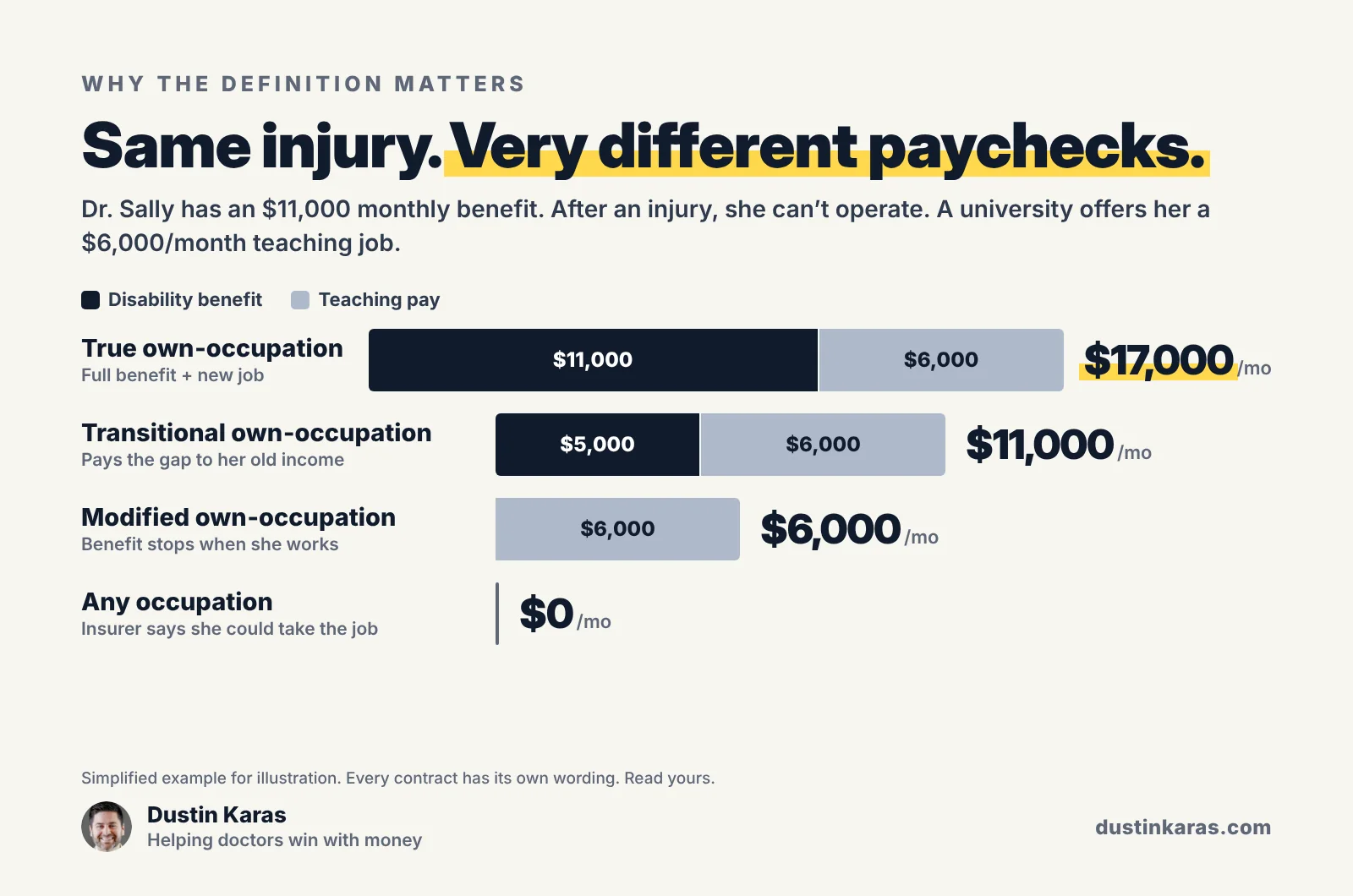
- True own-occupation: She keeps her full $11,000 and takes the teaching job. Total: $17,000 a month.
- Transitional own-occupation: Her benefit drops to $5,000 to fill the gap. Total: $11,000.
- Modified own-occupation: Her benefit stops when she starts teaching. Total: $6,000.
- Any occupation: She turns the job down, but the insurance company says she could do it. Total: $0.
Same doctor, same injury. The only difference is a few words in the contract.
That’s why true own-occupation is the only definition I encourage doctors to buy. It lets you start a new chapter, like teaching, research, or consulting, without being punished for it. I know doctors who did exactly that after a disability. A few of them now help other doctors buy disability insurance.
What to look for in the contract: language that says you’re disabled if you can’t perform “the material and substantial duties of your occupation,” even if you’re working in another occupation. Then check that “your occupation” means your medical specialty, not just “physician.”
One trap: some employer plans call themselves “own occupation,” but only for the first 24 months of a claim. After that, they switch to any occupation.
4. The features worth paying for
Once the definition is right, look at the rest of the contract. Some features are must-haves. Others are nice extras.
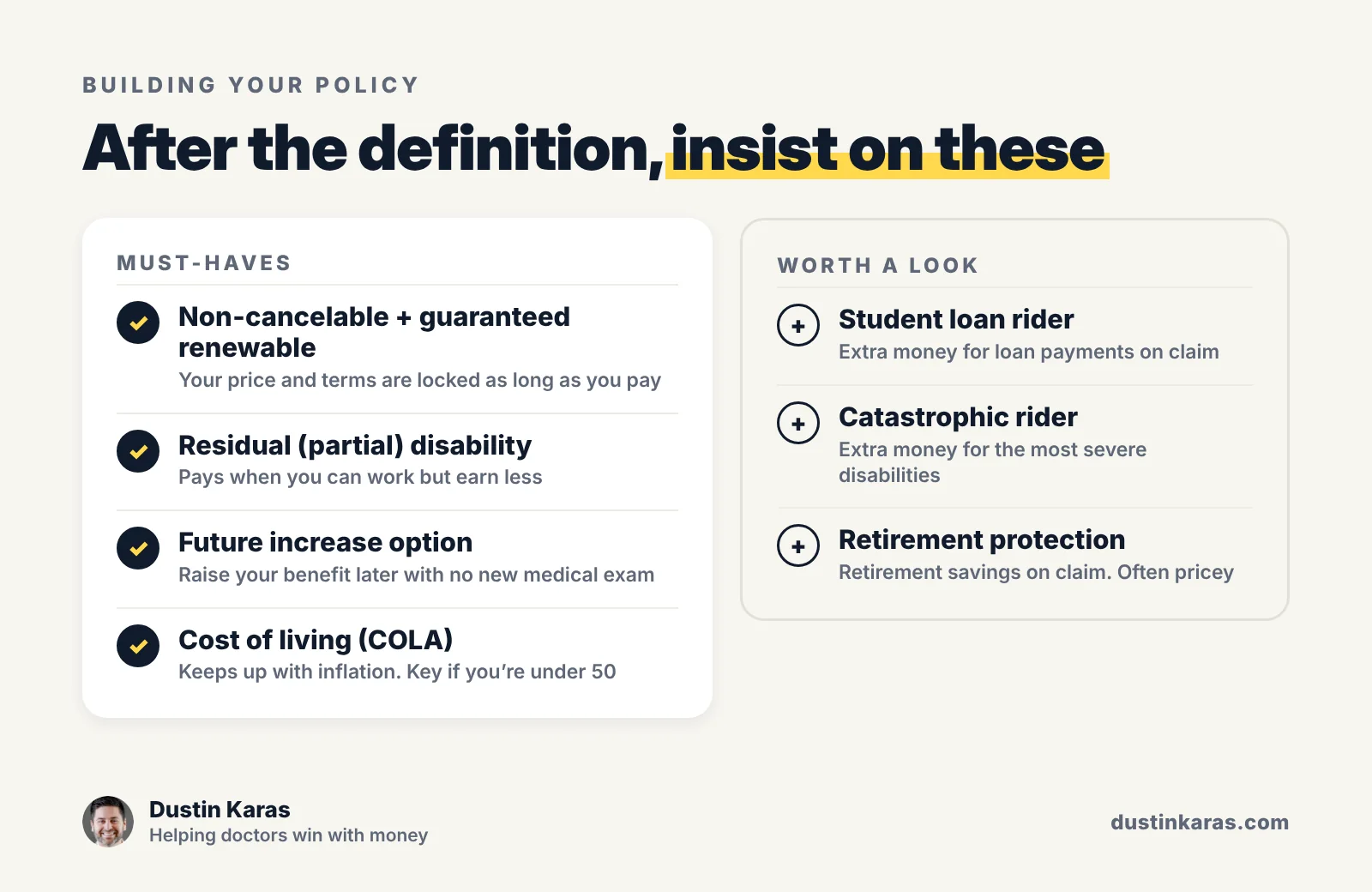
The must-haves
- Non-cancelable and guaranteed renewable. Two contract features you want together. Non-cancelable means the company can’t raise your price or change your policy as long as you pay. Guaranteed renewable means they can’t cancel you. On its own, though, guaranteed renewable still lets them raise rates for a whole group of policyholders. You want both.
- Residual (partial) disability. Pays part of your benefit if you can still work but earn less because of an illness or injury. Most disabilities don’t knock you out completely. They slow you down. Picture a urologist who has a heart problem and can only handle half his usual procedures. Without this rider, he may get nothing. Make sure it includes a recovery benefit, which keeps paying while your income climbs back after you return. This is the one I’d fight for.
- Future increase option. Lets you raise your benefit as your income grows, without a new medical exam. This is huge for residents. You can usually use it until your mid-50s.
- Cost of living adjustment (COLA). Raises your benefit each year you’re on claim so it keeps up with inflation. Before a disability, raises and bonuses do that job. On claim, this rider does. It’s a must-have if you’re under about 50. Later in your career, it may not be worth the cost.
Worth a look
- Student loan rider. Adds money for loan payments while you’re on claim. Helpful for residents and new attendings with big balances. Optional.
- Catastrophic disability rider. Pays extra if you can’t do two or more basic daily activities, like bathing or dressing, on your own. Severe disabilities come with big new costs. It’s rarely used, but some doctors want that peace of mind.
- Retirement protection rider. Sets money aside for retirement while you’re on claim. It’s usually expensive, and insurance is rarely the best place to invest. Optional.
Two choices that change your price
- Waiting period (also called the elimination period). How long you must be disabled before benefits start. 90 days is the most common. A longer wait lowers your price, but make sure your emergency fund can cover the gap.
- Benefit period. How long the policy can pay. For doctors, I’d pick age 65 or 67. Shorter periods, like 5 or 10 years, cost less. But a career-ending disability doesn’t end in 5 years.
The mental health limit
Some policies cap mental health and substance use claims at 24 months in exchange for a lower price. Some carriers require it in certain states, and guaranteed standard issue plans usually include it. Our advisors rarely recommend paying extra to remove it. If mental health is part of your history, talk it through with someone who can show you both prices.
5. Who sells true own-occupation coverage
Lots of companies sell disability insurance. Only a few write strong, specialty-specific own-occupation policies for doctors. Most of those come from five carriers, often called the Big 5:
- Ameritas
- Guardian
- MassMutual
- Principal
- The Standard
They’re not the same. Definitions, prices, underwriting, and discounts vary by specialty and state. The best fit for a pediatrician in Ohio may not be the best fit for a surgeon in Florida. That’s why you compare them side by side before you buy.
6. What it costs and how to pay less
I wish I could give you one number. I can’t, because the price is built around you.
What drives the price:
- Your age and health
- Your specialty
- Your state
- How much monthly benefit you buy
- Your waiting period and benefit period
- Which riders you add
- Which discounts you qualify for
To give you a feel: many residents pay roughly $125 to $300 a month for $5,000 to $7,500 of monthly coverage.
Buy early if you can
The biggest lever is timing. Younger and healthier means less expensive, and doctors in training get discounts most attendings can’t.
Here’s an example from our team. Same doctor, same $5,000 monthly benefit, same policy design, three different starting points:
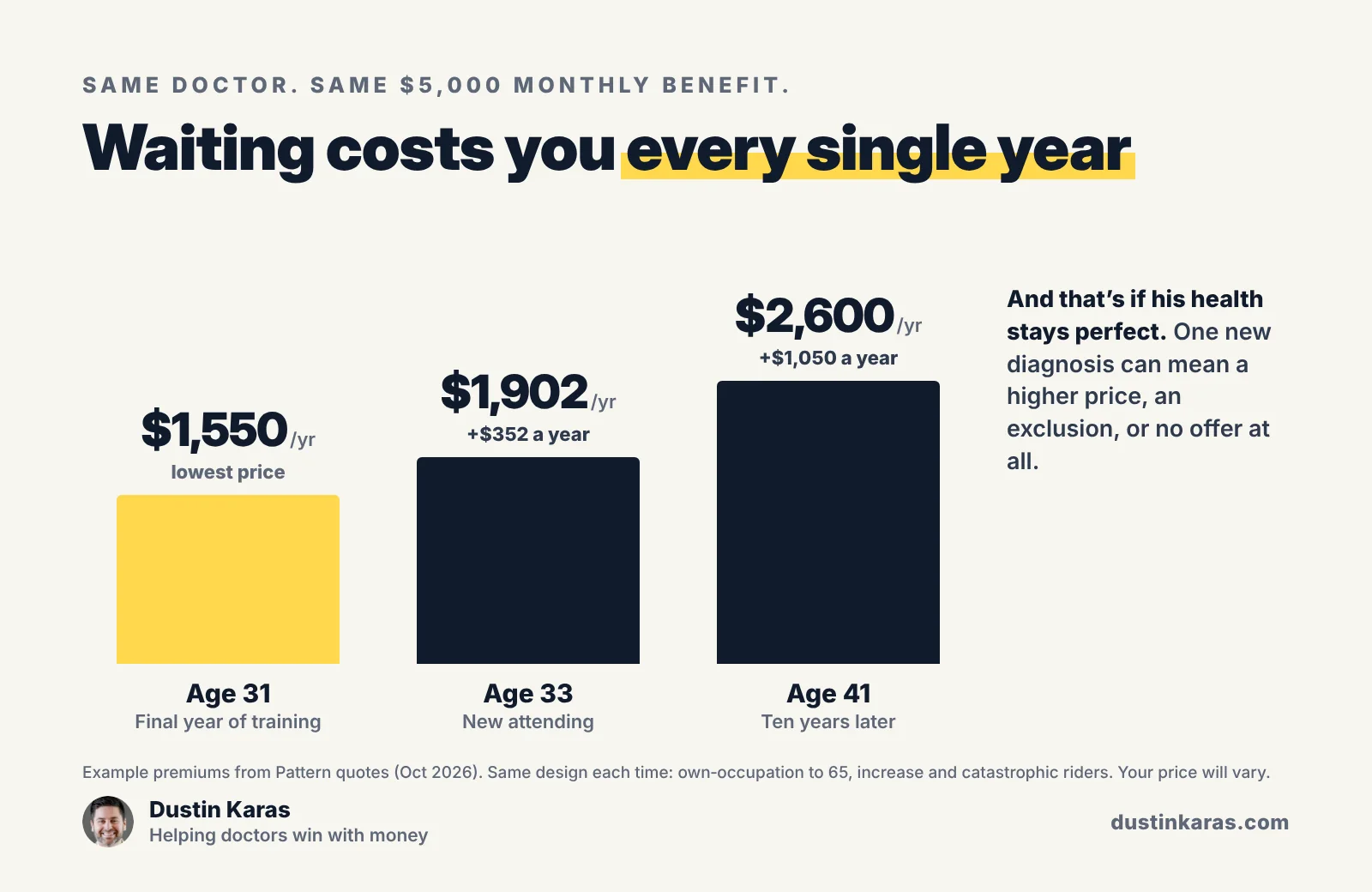
- Age 31, final year of training: $1,550 a year
- Age 33, new attending: $1,902 a year
- Age 41: $2,600 a year
Waiting two years cost him about $350 a year. Waiting ten cost him about $1,050 a year, every year. And that’s if his health stays perfect. One new diagnosis can make coverage cost more, come with exclusions, or not be available at all.
Discounts to ask about
- Training discounts. Often 10% to 20% for residents and fellows. Ask whether the discount is locked in for the life of the policy.
- Multi-life discounts. When several doctors at the same employer or program apply, carriers often take about 10% off.
- Guaranteed standard issue (GSI). Some residency programs and employers offer coverage with no medical underwriting. Helpful if you have a health history, but it’s not always the less expensive choice. More on this in the FAQ.
How much coverage can you buy?
Carriers cap your benefit based on your income and where you are in training.
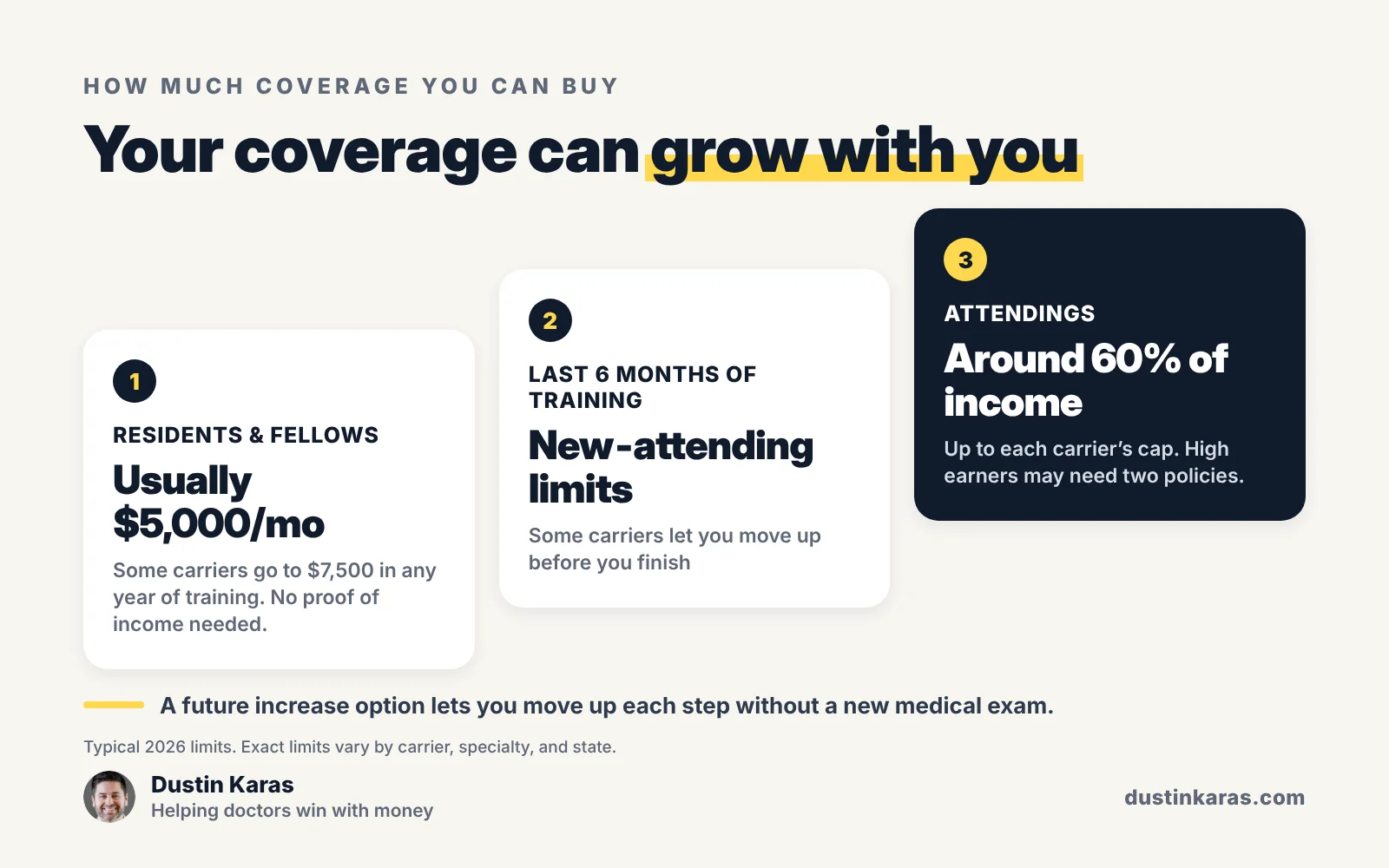
- Residents and fellows: usually up to $5,000 a month, with no proof of income. A couple of carriers now go up to $7,500 in any year of training.
- Last six months of training: some carriers let you move up to their higher limits for new attendings.
- Attendings: based on your income, often around 60% of it. Every carrier has a cap, so high earners sometimes need two policies.
My advice: buy as much as you qualify for. If you pay the premiums yourself with after-tax money, the benefits are generally tax-free. So a benefit worth about 60% of your gross pay lands close to your take-home pay.
And as you go from resident to attending, your future increase option lets you grow into the coverage your new income supports.
7. Your employer’s plan vs. your own policy
The question I hear most: “My hospital already gives me disability insurance. Why do I need my own?”
Because they’re built for different jobs.
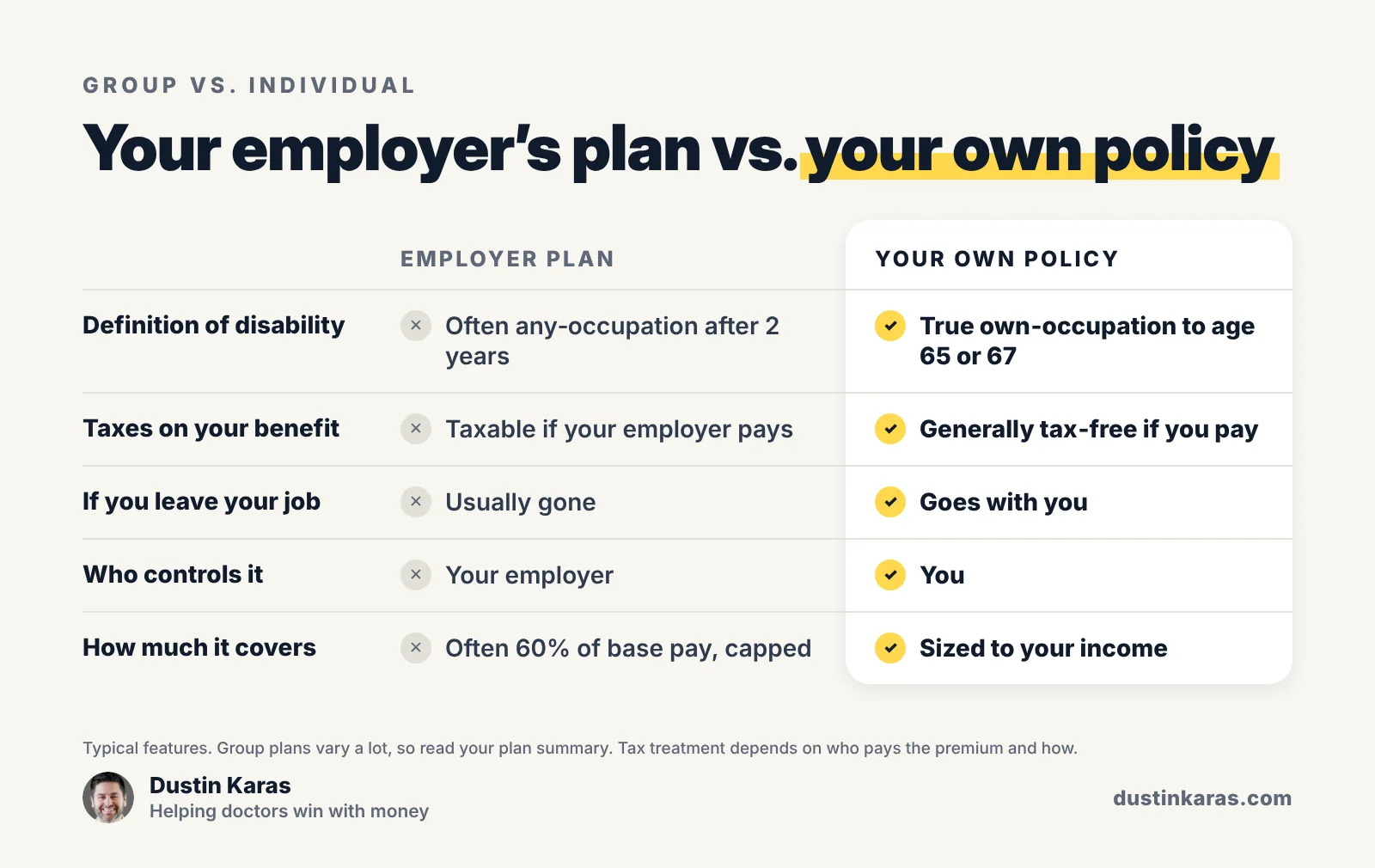
Where employer (group) plans fall short
- The definition is usually weaker. Many group plans switch to any occupation after 24 months. Some are any occupation from day one. That makes it harder to get a claim paid.
- The benefit is usually taxable. If your employer pays the premium, or you pay it with pre-tax dollars, your benefit counts as taxable income. That 60% shrinks fast.
- It stays with the job. Leave your employer and you usually lose the coverage. Lots of doctors change jobs early in their career. If your health has changed by then, buying your own policy can get expensive or impossible.
- Your employer controls it. They can change the plan or cancel it.
- The coverage is often capped. Many plans cover 60% of base salary only, often capped around $10,000 to $15,000 a month. Bonuses and productivity pay are usually left out. And many group plans reduce your check by whatever Social Security pays you.
When a group plan is still worth having
- It’s free. Take it, and stack it on top of your own policy.
- It has no medical underwriting. If a health condition keeps you from qualifying for an individual policy, group coverage may be your best option.
- It has fewer exclusions. Some group plans don’t exclude past conditions or risky hobbies like scuba diving or flying.
Group coverage is a nice extra. I just wouldn’t let it be your whole plan.
8. “Won’t Social Security cover me?”
Probably not. And even if it does, it won’t cover much.
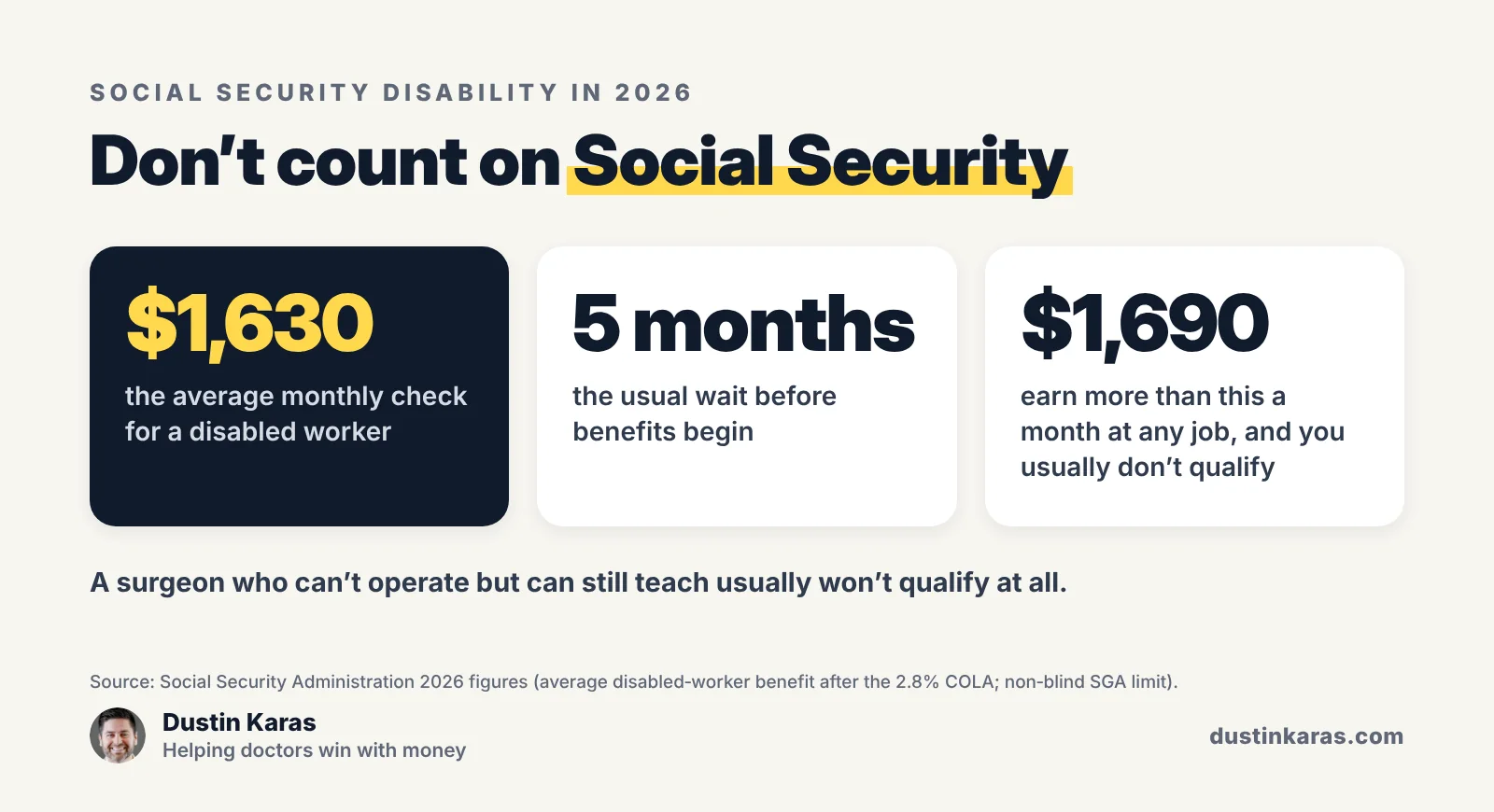
- The bar is very high. You generally have to be unable to do any substantial work. In 2026, earning more than $1,690 a month usually counts as substantial. Your disability also has to be expected to last at least a year or result in death.
- There’s a wait. Benefits generally don’t start until your sixth full month of disability.
- The check is small. The average disabled worker gets about $1,630 a month in 2026.
A surgeon who can’t operate but can still teach won’t get Social Security disability. With a true own-occupation policy, that same surgeon can collect the full benefit.
9. How to buy it
The simple version:
- Get quotes from all five carriers. Make sure whoever helps you can quote all of them, not just one.
- Compare them side by side. Definitions, riders, discounts, and price. The details that matter most are often in the fine print.
- Apply and go through underwriting. Expect health questions, a phone interview, and often a blood and urine test. The whole thing can take one to three months, so start early.
- Read your policy when it arrives. Make sure it says what you were told it says.
That’s what my team at Pattern does every day. We’re an independent broker, so we’re not tied to one company. You don’t pay us a fee. The insurance company pays the broker. If you want help comparing, start here: patternlife.com/disability-insurance
10. FAQ
Do I pay a fee to use a broker?
No. The only thing you’ll pay is your premium to the insurance company.
How do I know you don’t have a conflict of interest?
We’re an independent broker, not a captive agent for one company. We show you the options side by side and you pick.
Can I get coverage if I’m on a visa?
Often, yes. We’ve helped doctors on H-1B and J-1 visas, as well as green card holders. Rules vary by carrier and visa type, so ask before you apply.
What if I’m pregnant?
Many carriers will still issue a policy before your third trimester, usually with an exclusion for complications from this pregnancy. After that, most wait until after delivery. Future pregnancies are covered like anything else.
What is guaranteed standard issue (GSI)?
Coverage offered through some residency programs, hospitals, and groups with no medical underwriting. It’s a great option if you have a health history. But it’s often more expensive than a fully underwritten policy, with lower benefit limits and the 24-month mental health limit. And because agents have to meet participation requirements to offer it, they often recommend it even when you could get a better or less expensive policy elsewhere. If you’re healthy, compare first.
When should I buy?
As early as you can, ideally in residency or fellowship. You’re younger, probably healthier, eligible for training discounts, and you can buy coverage without proof of income.
When can I stop paying for it?
Once your savings and investments could replace your income for the rest of your life, you may not need it anymore. Until then, keep it.
Before you sign: the checklist
Save this one.
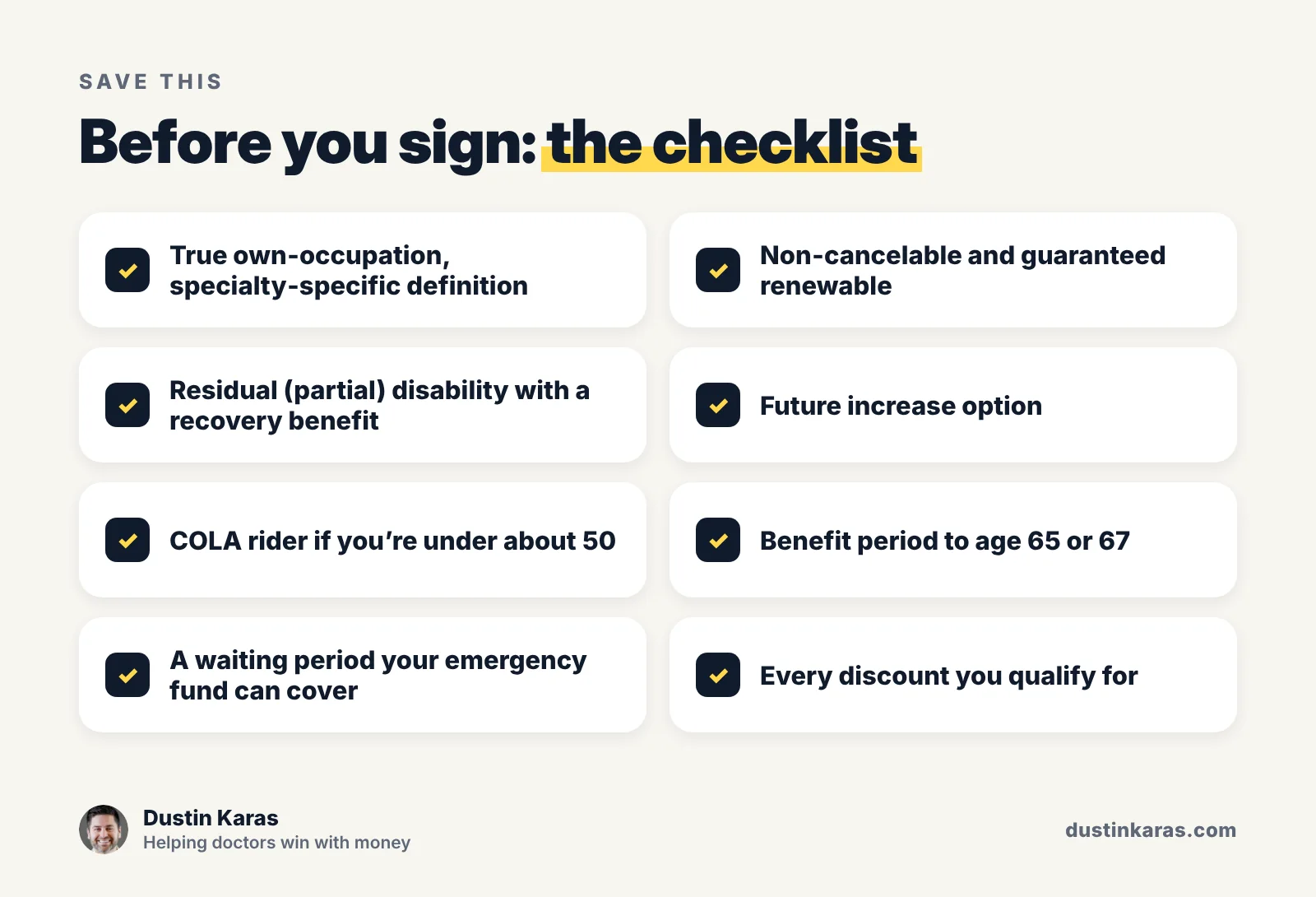
- True own-occupation, specialty-specific definition
- Non-cancelable and guaranteed renewable
- Residual (partial) disability with a recovery benefit
- Future increase option
- COLA rider if you’re under about 50
- Benefit period to age 65 or 67
- A waiting period your emergency fund can cover
- Every discount you qualify for
You spent more than a decade building the skill that pays your bills. Spend an hour making sure it’s protected.